If you have ever wondered why the lotus appears again and again in Hindu worship — under Lakshmi’s feet, in Saraswati’s seat, in Vishnu’s hand — you are noticing something that the tradition has repeated for thousands of years. The lotus is not decoration. It is the flower most closely tied to the deities of wealth, knowledge and preservation.
Lotus attar carries that fragrance into your daily pooja. This is a guide to what the lotus means in worship, and how the attar is used.
Why the lotus belongs to Lakshmi
Of all the flowers associated with Goddess Lakshmi, the lotus is the one that appears in nearly every description of her. She stands upon it. She holds it. She is described as being born of it.
The Sri Suktam — the ancient hymn to Lakshmi recited during her worship — returns to the lotus obsessively. One of its best-known verses addresses her as padmanane, padma uru, padmakshi, padmasambhave: lotus-faced, lotus-seated, lotus-eyed, lotus-born. Another verse calls her padmapriye — she who is fond of the lotus.
The hymn also instructs that those seeking her grace should worship with a clean body and a devoted mind, every day. Not occasionally. Daily.
This is the reasoning behind offering lotus fragrance in pooja. You are offering the deity the flower she is said to love most, on a day when fresh lotus blossoms are not available — which, for most households, is every day.
Saraswati, Brahma and Vishnu
The lotus is not Lakshmi’s alone.
Saraswati, goddess of knowledge, music and speech, is depicted seated on a white lotus. Where Lakshmi’s lotus signifies abundance, Saraswati’s signifies purity of mind and the unfolding of understanding.
Brahma, the creator, is described as emerging from a lotus that rises from Vishnu’s navel. Creation itself, in this telling, begins with a lotus.
Vishnu holds the padma as one of his four attributes, alongside the conch, discus and mace.
So when lotus fragrance is offered in the home shrine, it is not tied to a single deity. It sits naturally in worship of Lakshmi for prosperity, Saraswati for learning, and Vishnu in his own right.
Why the lotus, and not another flower
The lotus grows in muddy water and emerges clean. Nothing sticks to its petals. It opens with the sun and closes at dusk.
Hindu thought has taken this as an image of the soul: living in the world, touched by it, yet not stained by it. Detachment without withdrawal. That is why the lotus stands for prosperity that does not corrupt, and knowledge that does not turn to pride.
There is a practical reason too. Fresh lotus blossoms are seasonal, regional and expensive. Most families cannot place one before the deity daily. The fragrance can be offered every day of the year.
What lotus attar is
An attar is a concentrated fragrance oil, worn and offered without alcohol.
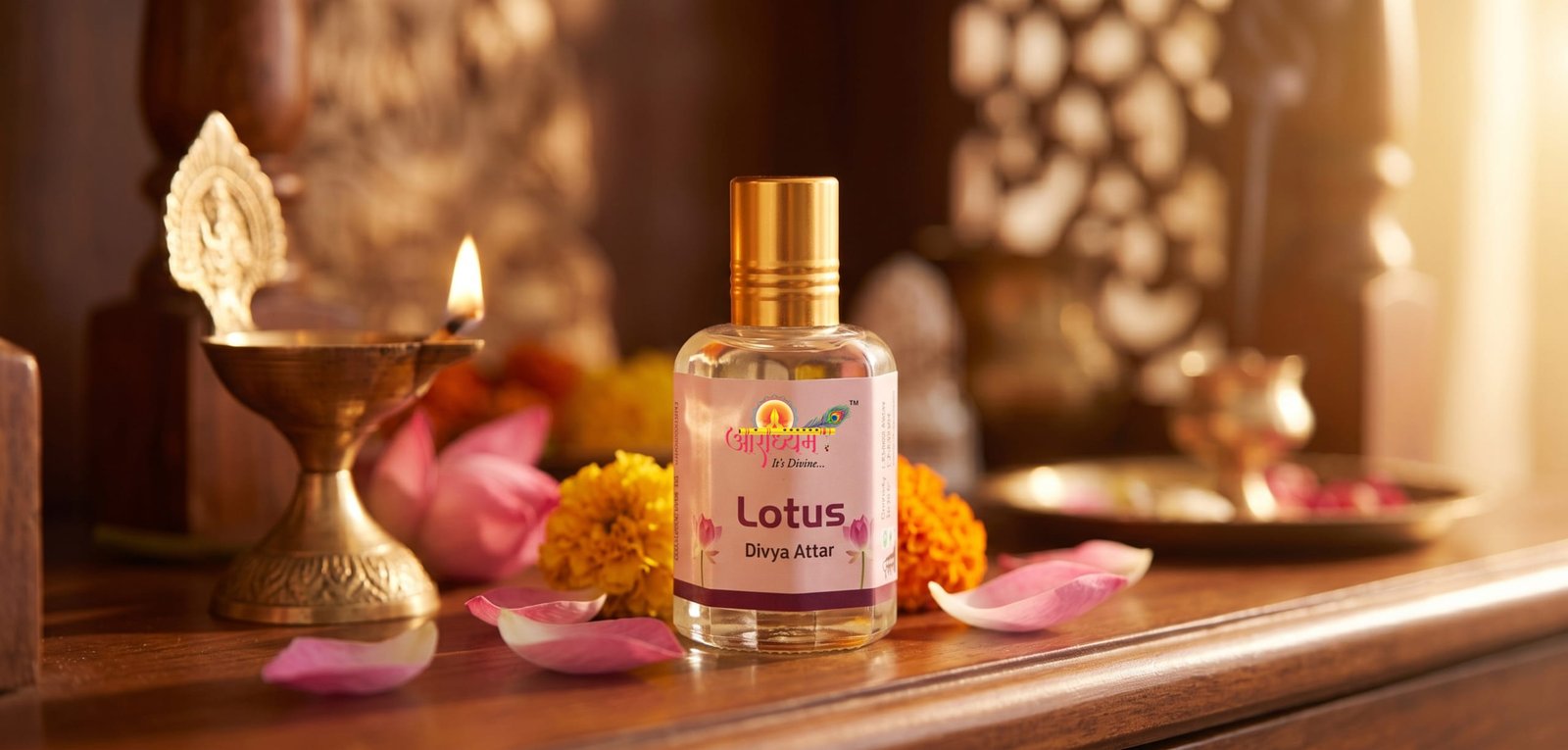
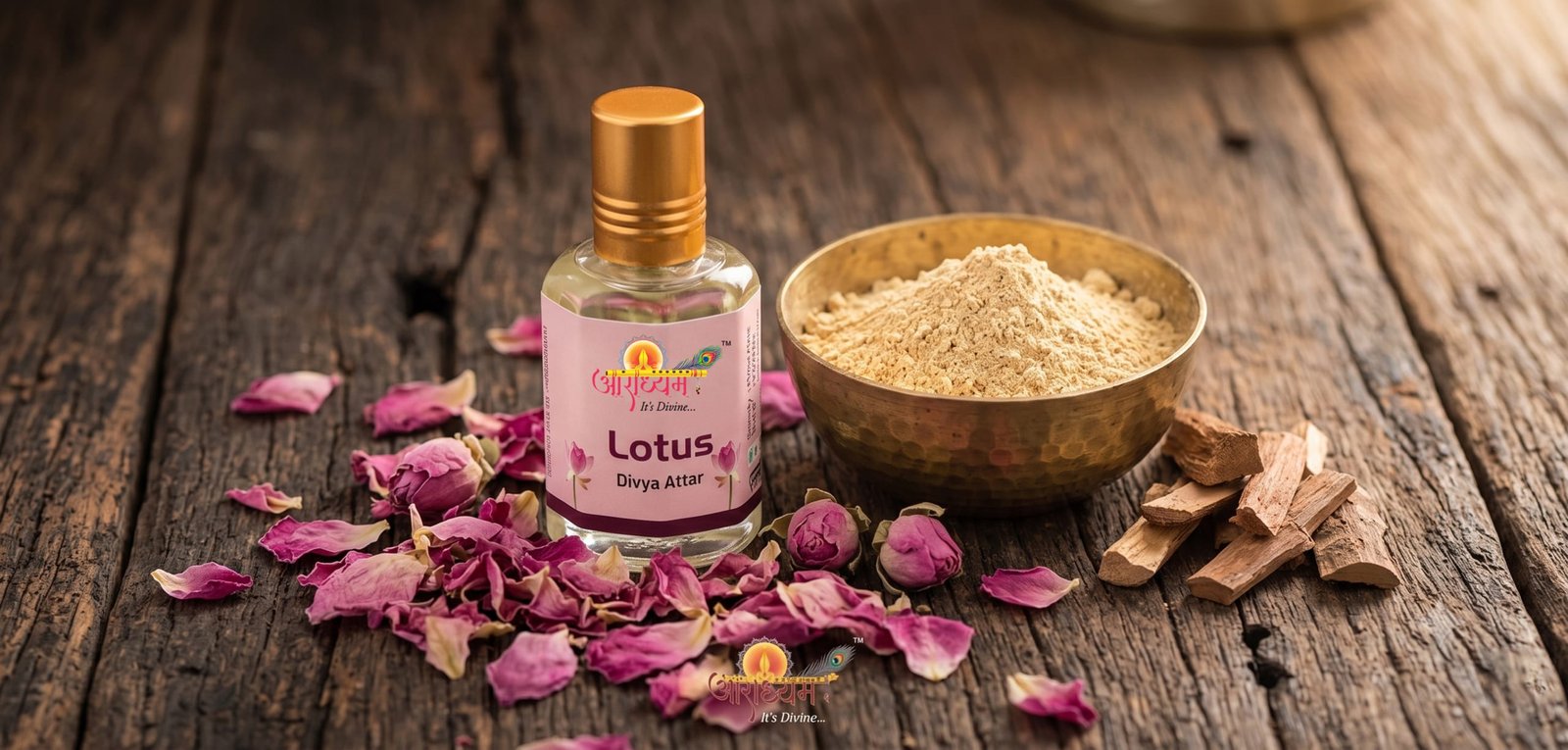
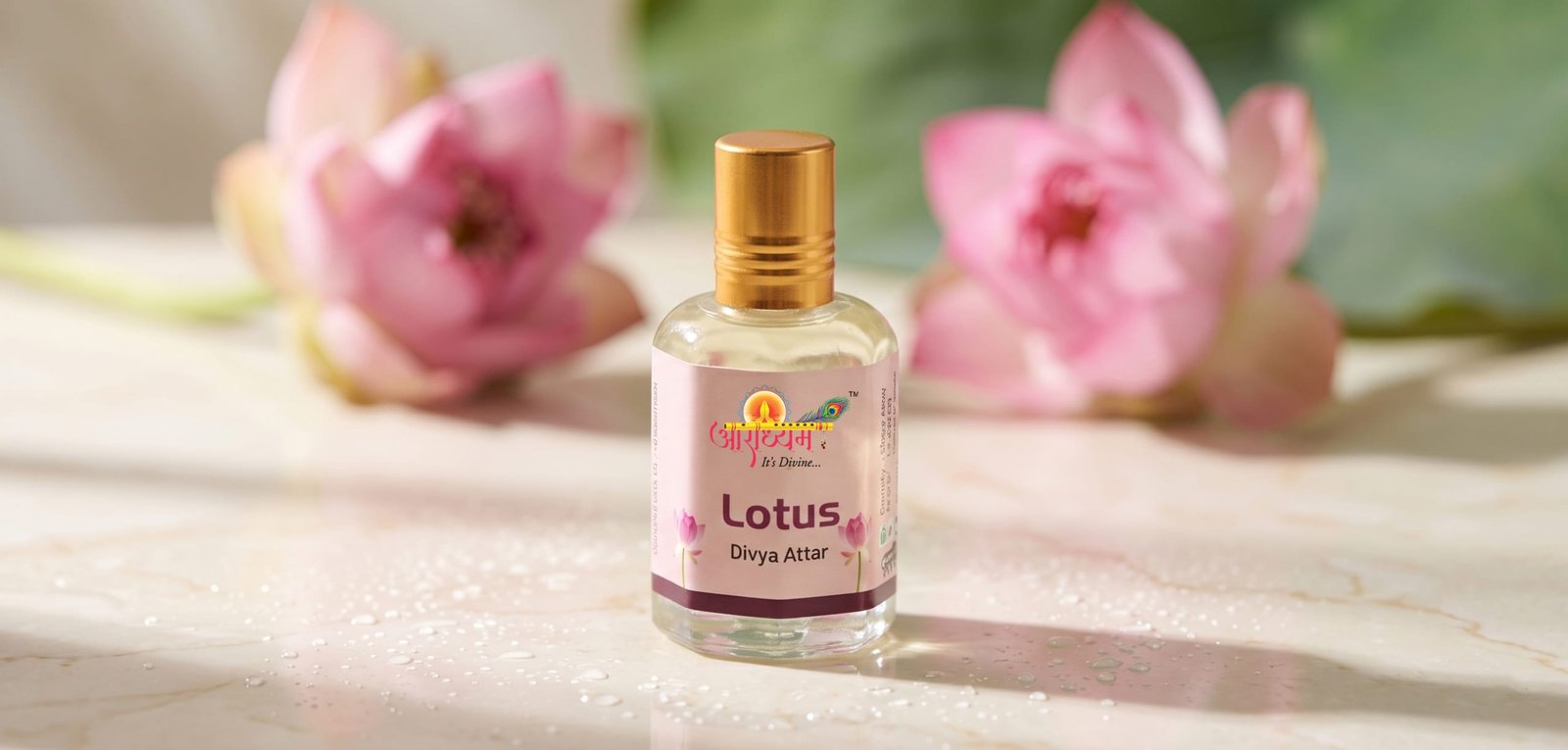
Our Lotus Attar is built around the fragrance of the pink lotus — the sacred lotus of Indian tradition — in a sandalwood oil base. Sandalwood is itself a pooja material with a long history in Hindu worship, so the base and the fragrance belong to the same world.
Because it contains no alcohol, it is suitable for use in worship, where alcohol-based perfumes are traditionally avoided. This is the main reason customers choose attar over perfume for religious use.
It is made in Vrindavan, and the materials are sourced from Mathura.
How to use lotus attar in daily pooja
On the idol or image. A drop applied to the deity’s feet or garments is the traditional offering. Use sparingly — attar is concentrated and a single drop carries a long way.
On your clothing. Many people apply a little to their clothes before sitting for pooja. On fabric the fragrance holds well, often lasting through a full day and into the next.
On the pooja cloth or altar. A drop on the cloth beneath the deity scents the whole shrine area.
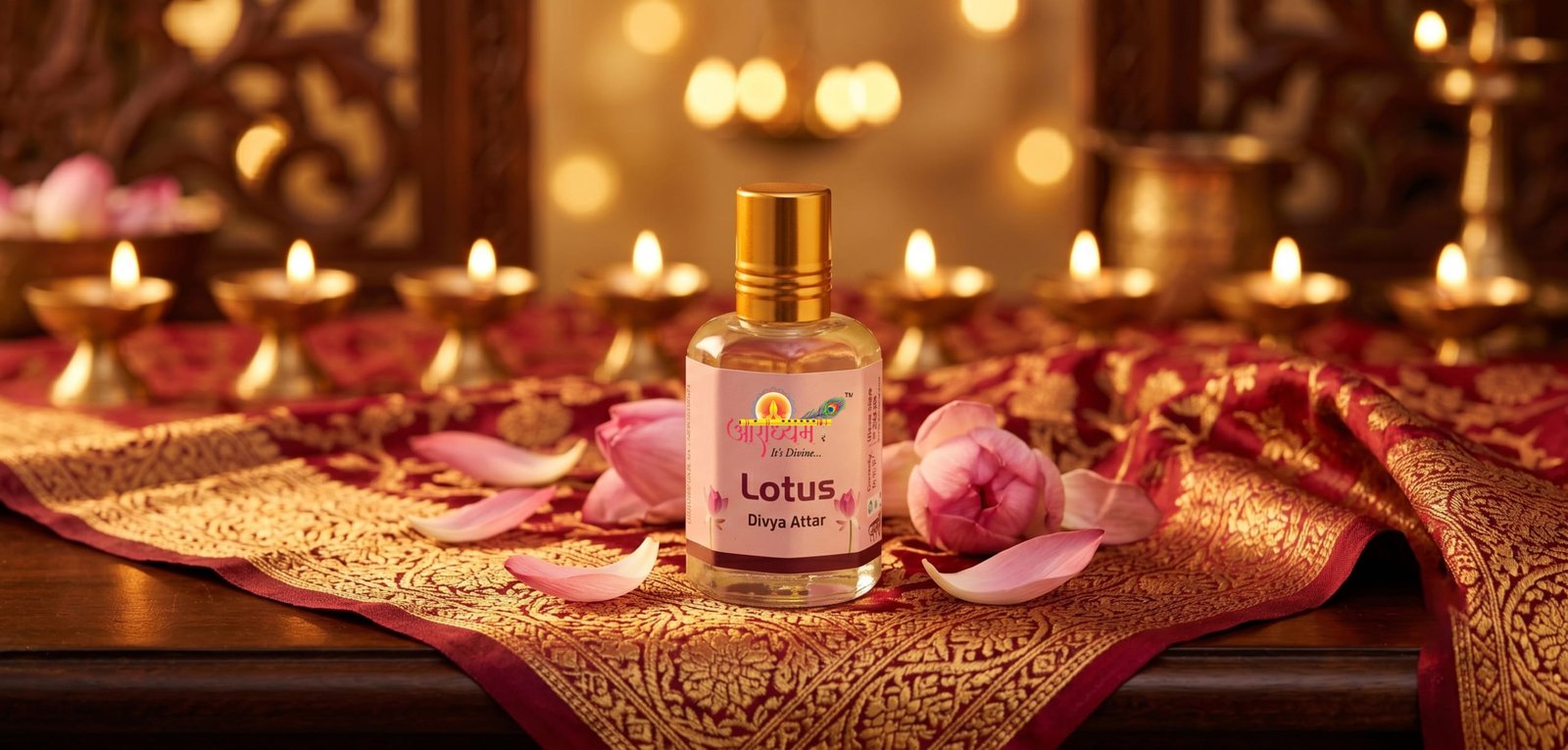
For Lakshmi Pooja and Diwali. Lotus attar is commonly used during Diwali Lakshmi pooja, when the household invokes prosperity for the year ahead. The lotus connection makes it a natural offering on that night.
For Saraswati Pooja and Vasant Panchami. Equally used when worshipping Saraswati, particularly by students and those in music, teaching or the arts.
A note on quantity: a 3 ml bottle lasts roughly a week for someone using it daily in pooja. The larger sizes are for regular or household use.
Can lotus attar be worn?
Yes. This is the point most people miss about attars.
Attars are often treated as strictly religious items, used only before the shrine and nowhere else. But lotus attar works perfectly well as a personal fragrance — applied to clothing, it is soft, floral and long-lasting, and suits both men and women.
There is nothing improper about this. Fragrance has been worn in India for as long as it has been offered. The same bottle can serve your morning pooja and your working day.
Sizes available
Lotus Attar comes in 3 ml, 6 ml, 12 ml and 25 ml. The 3 ml is a sensible starting point if you are new to attars or want to try the fragrance before committing. The larger sizes work out more economical for daily use or for households where more than one person uses it.
Browse the full range in our Religious Attars collection, or see our Wearable Attars for fragrances intended more for daily wear.
Storage: keep the bottle closed, away from direct sunlight, and out of reach of children.
Frequently asked questions
Is lotus attar linked to any planet or astrological benefit?
In devotional practice the lotus is tied to deities rather than to planets. Its association is with Lakshmi for prosperity and Saraswati for knowledge, and that is the tradition we would point to. We would not claim a specific astrological effect — the reason people use it is devotional, and the scriptural grounding for that is clear.
Can lotus attar be applied directly to skin?
We recommend applying it to clothing rather than skin. It performs best on fabric and lasts considerably longer there.
Is lotus attar alcohol-free?
Yes. It is made in a sandalwood oil base with no alcohol, which is why it is suitable for use in pooja.
Which deity is lotus attar used for?
Most commonly Lakshmi, and also Saraswati. The lotus is associated with both, and with Vishnu, who holds the padma.
How long does a bottle last?
A 3 ml bottle lasts around a week with daily use. Larger sizes last proportionally longer.
Can men use lotus attar?
Yes. It is used by both men and women, for worship and for wear.